
TEACHINGS: Mythology & Tantra
Mythology & Tantra
This page is an introduction to mythology and tantra as I understand them, after more than twenty years of study and practice. I am Daniel Paulus.
Myth is not a collection of childish stories a rational age has outgrown, and tantra is not a sexual technique. Both of these are popular distortions, and both lose almost everything that matters. Myth is the oldest and most precise language the human psyche has for describing its own transformation. Tantra is a complete path that reads the body, the senses, and the world as that same transformation made practice. They belong on one page because they are two forms of one understanding: that the gods are forces of consciousness, and that the inner world has a structure which can be both spoken in image and walked as a path.
I work from the living Śrī Vidyā tradition, into which I was initiated, and from Jungian depth psychology. I do not merge them into one doctrine. I translate between them, I separate the authentic from the distorted, and I treat myth and tantra as the symbolic and the practical face of the same inner reality.

Myth and tantra are the two most misunderstood subjects I teach, and the misunderstanding is the same in both cases: a precise inner science mistaken for either a children's tale or a sensual indulgence. This page restores both. Myth as the language the unconscious actually speaks, read across Greek, Norse, and Indian traditions; the hero's journey, the descent, and the shadow made visible in the terrifying gods. Then tantra as the authentic path it was before the West rewrote it: Shiva and Shakti, the subtle anatomy of kundalini and the chakras, the transmutation of desire, the tools, and the living lineage of Śrī Vidyā with its goddess at the centre. Written by someone initiated in the tradition rather than describing it from outside.
On this page
1. Why mythology and tantra belong together
3. Myth as the language of the unconscious
4. The development of consciousness and why myth is hard for us now
5. Myth between psychology and the sacred
6. The hero's journey and the descent
7. The heroine's journey and the personal myth
8. Anima, animus, and the inner partner
9. The terrifying gods and the shadow
10. The Fisher King: the wound and the healing question
12. What tantra is, and what it is not
14. The core: Shiva and Shakti
15. The body as temple: microcosm and macrocosm
16. Kundalini and the subtle anatomy
17. The three knots: a map shared with psychology
18. The transmutation of desire
20. The schools and the lineage
21. Śrī Vidyā and the Divine Mother
23. Tantra and myth: gods as forces of consciousness
1. Why mythology and tantra belong together
These two subjects are the most distorted of everything I teach, and they are distorted in the same way. Myth has been reduced to a quaint story for children, something a rational adult sets aside. Tantra has been reduced to a technique of sensual pleasure, something a curious adult tries out. In both cases a precise inner science has been mistaken for its shallowest surface, and in both cases what is lost is the same thing: the knowledge that the human interior has a real structure, and that this structure can be both spoken and walked.
Here is the link that holds the page together. Myth is the language in which the psyche describes its own transformation, in image rather than in concept. Tantra is the path that takes that same transformation and makes it a practice, working through the body, the breath, the senses, and the symbol. The gods of myth and the deities of tantra are not two different populations. They are the same forces of consciousness, met once as story and once as practice. When tantra visualises a goddess, it is not addressing an external being; it is activating a quality of consciousness that myth had already named. Myth gives the map in pictures; tantra walks the territory.
This is why I refuse to treat either as decoration. A person who reads myth only as literature, however beautifully, has missed that it is a description of their own inner life. A person who approaches tantra only as technique, however earnestly, has missed that the technique is meaningless without the symbolic world that gives it direction. Held together, the two restore something the modern mind badly lacks: a way to speak with the unconscious, and a way to work with it, that does not reduce the soul to either a story or a sensation.
2. What myth actually is
A myth is not a failed explanation of nature that science has since corrected, and it is not a simple tale for entertainment. It is a precise account, in the language of image, of what happens inside a human being. Where modern thought separated fact from meaning and kept only the fact, myth keeps the meaning, and it keeps it in the only form deep meaning can take, which is the symbol.
This is why the same motifs appear across cultures that never met. The hero who must leave home, the descent into the underworld, the death and the rebirth, the monster that guards the threshold, the sacred marriage of opposites: these are not borrowings passed from one people to another. They are the common structure of the human interior, surfacing independently wherever human beings have tried to describe the shape of their own becoming. Greek, Norse, Slavic, Indian, biblical: the outward details differ, the underlying structure is one. A culture that loses its myths does not become more rational. It loses the map of its own inner life, and a generation cut off from that map is, in my observation, more prone to confusion and to a particular kind of rootless suffering, because it has no language for the very transformations it is living through.
Read this way, myth is not the opposite of psychology but its oldest form. Long before there was a science of the soul, there was the story of the soul, and the story was often wiser than the science that replaced it, because it never made the modern mistake of confusing a person's surface with the whole of them.
There is a particular loss worth naming, because it bears directly on the suffering I see most often. A traditional culture hands its children its myths and the fairy tales that descend from them, and these are not entertainment but a kind of preparation. They give a young person, long before they can articulate it, a set of images for the experiences that have no rational shortcut: leaving home, facing the monster, being betrayed, descending into grief, finding the helper, undergoing the ordeal that changes them. When a culture replaces these with empty spectacle, stories engineered for stimulation rather than meaning, it does not simply lower the quality of children's entertainment. It takes away that preparation. A generation raised on images without depth arrives at the genuine ordeals of adult life with no inner map for them, and in my observation this rootlessness shows up later as a specific vulnerability, a difficulty in finding meaning, a sense that one's own hardest experiences are random and shapeless rather than part of any recognisable human passage. The repair is not nostalgia. It is the recovery of myth as what it always was, a precise and practical language for the shape of a human life.
This is also why myth cannot be replaced by a moral or a summary. The meaning of a myth is not a lesson that can be extracted and the story then discarded. The meaning is in the images themselves, in their particular strangeness, in the way they refuse to resolve into a single tidy point. A myth that has been reduced to its moral has been killed, in the same way a dream is killed by a one-line interpretation. The story has to be kept whole, entered, and lived with, because it works on the level of image and that level cannot be paraphrased into concept without losing exactly the thing that gives it power.
It helps to say plainly what work myth does, because it is not one thing but several at once. Myth gives suffering a meaning: when I see my own wound or loss inside a more than personal story, it stops being my isolated grievance and becomes part of the oldest human drama, which does not remove the pain but ends its muteness. Myth shows patterns of action, models for the things that matter most, for love, work, raising children, and dying. It orients a person in what to do, because the mythic world, unlike the scientific one, is a place not only to observe but to act in, and it helps answer the hardest question, what ought to be and which way to go from an unbearable state. It preserves wisdom, the treasury into which humanity has placed its experience for millennia, reached for exactly when the rational ways of solving a thing have failed. And it opens the sacred, since the images of the gods are not literal descriptions of the cosmos but means of waking the mind and turning it towards what lies beyond words. These functions are not fixed forever; a symbol long in circulation wears out and becomes an empty phrase, which is why the myths so often return to the image of the ageing king who must be replaced so that the ruling principle can renew itself.
It is worth distinguishing myth from its near relatives, because precision here sharpens everything that follows. A myth proper is bound to a particular civilisation and tells a sacred history, what happened at the beginning of time, establishing for that culture a basic truth about the world; it is not rationally provable but carries an intuitive truth founded on experience. A legend is a report of a specific marvellous event, tied to a named place, time, and person, showing the charged relationship of human life to the other world. A fairy tale arises by abstraction from legend: once the name and the place fall away and the story begins with there was once a miller, the tale detaches from the complications of a particular civilisation and presents the archetype in its purest, pared-down form, which is exactly why Marie-Louise von Franz read in fairy tales the most general anatomy of the human psyche. And against all of these stand dogma and doctrine, the artificial forms meant to explain and defend an original experience of the sacred to people who never had it, which hold an overwhelming encounter in a bearable shape but risk hardening, in time, into an empty programme of reassuring answers from which the mystery has evaporated.
3. Myth as the language of the unconscious
The reason myth works is that the unconscious does not think in concepts. It thinks in images. This is the single most important thing to understand about why old stories retain their power over people who no longer believe a word of them literally. A myth reaches a level of a person that an argument cannot, because it speaks the native language of that level.
C. G. Jung gave this its modern formulation with his idea of the archetypes, the archetypes, the universal patterns of the human psyche that appear, independently, in the myths of every culture. The Mother and the Father, the Hero and the Shadow, the Wise Old Man, the Trickster, the sacred union of masculine and feminine: these are not literary inventions but inborn forms, and myth is the record of how humanity has met them. When a myth moves you for reasons you cannot quite explain, it is because it has touched an archetype alive in your own depths. This is also why a myth cannot be exhausted by a single interpretation. Like a dream, it is translated rather than decoded, and its meaning is found in relation to the life of the one it speaks to.
There is a practical consequence here that matters for inner work. Because the unconscious answers to images and not to instructions, a person cannot simply reason themselves into change. The conscious decision to be different rarely reaches the level where the pattern actually lives. Myth, symbol, ritual, and active imagination work precisely because they address that level in its own tongue. This is the bridge to tantra, which is built entirely on this principle: that the way to reach and transform the depths is not through argument but through image, sound, and symbol consciously engaged.
4. The development of consciousness and why myth is hard for us now
Myth is bound to a particular way of perceiving the world, and that way has changed across history. Two thinkers help me most here. Erich Neumann, whom Jung considered his most gifted successor, showed that the myths of the world, read in the right order, tell one great story, the birth of consciousness out of the unconscious, and that the same development humanity passed through is repeated in miniature by every child and every one of us. He traced three great stages: an original undivided wholeness, the uroboros, the serpent eating its own tail, in which there is as yet no I and no other; the rule of the Great Mother, on whom a still weak ego depends and by whom it risks being devoured; and the patriarchal stage of the hero, in which the ego at last separates, says I am I, and goes out to fight the dragon of the unconscious, free the captive, and found a new order. This is not ancient history. It is the map of how a self forms, in a culture and in a person.
Jean Gebser went further and described the whole history of consciousness as a sequence of structures: the archaic, the magical in which a person merges with the world, the mythical whose language is image and story and whose form is the circle, and then the mental-rational structure, our own, which divides and measures. Here is the explanation for why we find myth so hard. Myths arose in the mythical structure and speak in image and polarity; we read them from the mental structure, which wants single meanings and facts. Myth cannot be understood until we learn again to see in images and not only in concepts. Gebser did not want us to go backwards; he pointed towards what he called the integral structure, able to hold all the earlier ones at once. This is the same integral consciousness I describe in the work on psychology and consciousness, approached from the side of myth.
5. Myth between psychology and the sacred
There is a distinction here on which the whole depth of reading myth depends, and it is easy to get wrong in one of two directions. Modern psychology was born wanting to be a natural science, to measure and repeat, and in that frame there is no room for the sacred; Freud went furthest, reading myth and religion as projected wish and collective neurosis, something the mature person should outgrow. Read this way myth loses all its own value and becomes a mere symptom to be interpreted and set aside. And yet, because the unconscious does not speak in concepts but in images, characters, and events, exactly the language of myth, to dismiss myth as superstition is to lose access to a whole layer of oneself that can express itself in no other way.
But the opposite error waits as well. The purely Jungian approach, left unguarded, tempts a person to reduce myth to mere projection of the psyche: the dragon is only the shadow, the goddess only the anima, the god only the father archetype. Everything is translated inward and nothing is left outside, and this second reduction loses something essential too. This is why, alongside Jung, I read Mircea Eliade, who was not a psychologist but a historian of religion. Eliade shows myth as a return to sacred time, as an opening to what genuinely exceeds the human. He described hierophany, the showing of the sacred in an ordinary stone or tree or place that becomes more than itself without ceasing to be itself; sacred time, illud tempus, the time of the beginning that ritual does not merely commemorate but re-enters; and the axis mundi, the world tree or sacred mountain at the centre, which has its inner counterpart in what Jung called the Self. The truth, as I hold it, lies in the tension between the two: myth is the language of the unconscious and a gate to transcendence at once. Read only psychologically, it loses the sacred dimension; read only religiously, it loses the insight into one's own depths. Only by holding both faces together does myth speak in full force, and that tension is perhaps the hardest and the most important thing in the whole work with myth.
6. The hero's journey and the descent
Of all the patterns myth records, two are worth drawing out, because they describe the actual shape of transformation and a person living through them is helped immensely by recognising where they are.
The first is the hero's journey, the pattern Joseph Campbell traced across the world's mythologies. A person is called away from the familiar, crosses a threshold into an unknown country, faces trials and a supreme ordeal, and returns changed, carrying something of value back to the community they left. This is not an adventure story. It is the structure of every genuine transformation, including the quiet inner ones. The call may be a crisis, a loss, a restlessness that will not settle. The threshold is the decision to take it seriously. The ordeal is the encounter with whatever in oneself has been avoided. And the return is the integration of what was found, brought back into an ordinary life that is now lived differently. A person who knows this shape suffers the difficult middle of it with less bewilderment, because they understand that the ordeal is not a sign of failure but the centre of the journey.
The second is the descent, the night sea journey, the going-down into the underworld. Inanna stripped at each gate of the descent, Persephone taken below, Odysseus and Aeneas visiting the dead, Christ harrowing hell: the motif is everywhere, and it describes something the upward-striving modern fantasy of growth refuses to admit, that real transformation passes through a darkening. There is a phase in any honest inner work that feels like loss, like dissolution, like the ground giving way, and the myths insist that this is not the path going wrong but the path going through its necessary depth. The alchemists called it the nigredo, the blackening. The descent myths called it the underworld. The reason these images console is that they tell a person in the dark that others have been here, that the dark has a shape and a far side, and that the way out is through.
It is worth dwelling on why this matters so much for the people I tend to work with, who are often capable, successful, and quietly bewildered that competence has not protected them from an inner crisis. The modern story of a life is a story of ascent: more skill, more status, more control, a line that should go up. The descent myths tell the opposite and older truth, that there are passages of life whose whole meaning is downward, into grief, into the unlived parts of oneself, into what was refused. A person who has only the ascent story available reads such a passage as catastrophe or as personal failure, and fights it, which makes it worse. A person who knows the descent as a recognised stage can let it do its work. The myth does not remove the difficulty, but it removes the second, needless suffering of believing the difficulty should not be happening. This is the concrete, practical use of myth, and it is why a culture that has forgotten these stories leaves its people undefended at exactly the moments they most need a map.
There is one more thing the descent myths insist on that is easy to miss. The point of the descent is never the darkness itself, and the traditions that linger in suffering as if it were holy have misread their own stories. In every version there is a return. Inanna comes back up through the gates, Persephone rises each spring, the hero climbs out of the underworld carrying something that could only have been found below. The descent is in service of the return, and what is brought back, some piece of oneself recovered from the dark, is the whole reason for the journey. This is the difference between depression, which is a descent with no return, and the genuine night sea journey, which is a descent that completes itself. A great deal of inner work is simply the difference between being stuck in the underworld and passing through it, and the old stories are, among other things, instructions for the passage.
7. The heroine's journey, and the personal myth
The hero's journey as Campbell drew it is general, but seen from the mythopoetic and Jungian side, masculine and feminine ripening follow somewhat different patterns, and it is worth distinguishing them. The masculine path, as Robert Bly described it through the tale of Iron John, moves through a separation from the world of the mother and a descent into the ashes, years on the bottom, in loss and humbling, where the man meets his own wound and learns to carry it as a gift, and makes contact with a deep instinctual energy Bly called the wild man, which is not aggression but a connection to one's own nature that civilisation often suppresses in men.
The feminine path, as Robert Johnson read it through the myth of Eros and Psyche, runs differently, not primarily through battle and the descent into ashes but through relationship, loss, and a return to one's own nature. Its instrument is not the sword that divides reality into opposites but the lamp, the warm light under which something can grow. Psyche begins in an unconscious paradise where she has everything but may not look at her husband or ask; roused by doubt, she lights the lamp and sees Eros as he is, losing her blissful naivety but beginning her real development. To find him again she must complete four seemingly impossible tasks, each teaching her to use the masculine force, the animus, consciously without losing her feminine nature: to sort a great heap of seeds, bringing order to the confusion of her own feelings; to gather the wool of the golden rams without going against their force head on; to draw water from the river of the underworld, learning focus amid chaos; and to descend into the underworld for the box of beauty, learning to say no and not to spend her compassion on everything that calls to her. Both paths, masculine and feminine, lead to the same goal of wholeness, through different country.
Myth is not only something we read; everyone lives one, knowingly or not. Jung called it the personal myth, the inner story of who we are, where we come from, and where we are going, and he held it to be one of the most important things we can know about ourselves. The story must change as we mature: the myth that carried us at twenty often stops working at forty, and when we do not rewrite it, it begins to suffocate us. A great part of the crises of adult life come from living by an old story that no longer fits who we have become. Jung himself reached the idea through a personal crisis, asking what myth he was actually living, finding he did not know, and making the discovery of his own myth the task of a lifetime. The key, he found, is a change in the central question: a person does not discover their myth while asking what others want of them or how to win approval, but only when they begin to ask what the deeper forces in them intend through them.
8. Anima, animus, and the inner partner
One of Jung's most important findings is that within each of us lives an inner figure of the opposite sex. In a man it is the anima, his inner feminine, feeling, relational side; in a woman the animus, the inner masculine principle of decisiveness, order, and direction. These figures appear constantly in myth. When the hero frees a maiden imprisoned in a dragon's cave or a tower, he is not only rescuing a girl from a story; symbolically he frees his own anima, his feeling and relational side, from the grip of the unconscious, and the marriage at the end of the tale is the image of an inner union in which the conscious self joins with its previously split-off side and becomes whole.
As long as the anima or animus stays unconscious, we project it outward onto other people. A man seeks his inner anima in an actual woman and is disappointed when he does not find her there, because he is looking in the wrong place; a woman does the same with the animus. Maturity in relationships begins when we recognise this inner figure as our own and stop demanding it from the other person. The anima has many faces in myth, oscillating between goddess and seductress, from Circe who turns men into animals to the Sirens whose song lures to destruction; the animus carries the principle of spirit and meaning, positive as initiative and courage, negative as a rigid, argumentative inner voice of fixed judgements. This is the work of relationship read from the inside, and it is the same material I develop on the psychology side.
9. The terrifying gods and the shadow
There is a feature of the world's mythologies that the sanitised modern versions quietly remove, and it is precisely the feature that matters most. The gods are not all kind. Alongside the nurturing and the beautiful stand the terrible: Kali wearing a necklace of skulls, the goddess Chhinnamasta holding her own severed head, the devouring mothers, the wrathful protectors, the monsters that are also somehow divine. A tradition that shows only the gentle face of the sacred has, without meaning to, lied about the structure of reality and the structure of the psyche.
These terrifying forms are the face of what Jung called the shadow, the disowned and suppressed material of a personality, and the traditions that keep them do something psychologically precise. They do not look away from the dark, and they do not try to destroy it. They place a person face to face with it so that the suppressed force can be met and transformed rather than driven deeper. This is why meditation on a fearsome deity, on Kali, on Chhinnamasta, functions in the tradition as a kind of controlled confrontation with everything in oneself one would rather not know: the aggression, the fear of death, the destructive capacity. The point is never to indulge these forces and never to deny them, but to bring them into the light where they can be integrated, because a force that is integrated stops running the person from below.
This is also where myth and tantra and depth psychology meet in a single insight. In the myth of the goddess and the demon, the demons were often originally ascetics who gained power through real practice and then misused it; they are images of the ego swollen and turned against the whole. In one central story the goddess defeats the demon Mahisha only when she pins him and forces him to reveal his true form, and this is an exact psychological mechanism: a hidden cause of inner disturbance cannot be resolved until it is named and brought into the open, where it can no longer keep changing shape. To meditate on the goddess is to become one's own investigator, seeking the true cause of one's suffering rather than fighting its endless disguises.
The shadow is not only the dark and rejected, though. Robert Johnson pointed to something often overlooked: we frequently put our best qualities into shadow too, our strength, talent, or greatness, because we never learned to carry them. This is the golden shadow, and we recognise it by whom we admire. When someone strongly attracts us, when we look up to a hero or a model, we often see in them our own finest, as yet unlived quality, projected onto them. The task is not to remain in admiration but to take that quality back and begin to live it ourselves.
There is one more figure the sanitised versions remove, and the world cannot move without it: the trickster, the joker and deceiver, half animal and half god, a collective shadow figure who mirrors a barely awakened consciousness still full of instinct and folly. The trickster holds a mirror up to civilised man, reminding him how he looked yesterday, and so guards against pride and the loss of contact with instinct. Bly notes that the trickster strikes when a person is too smug or too rigid in some Law, attacking the inflated ego through mischief and strange accidents. Coyote, Hermes, the alchemical Mercurius, the Norse Loki, and Prometheus who steals fire and suffers for it: each runs the trickster's arc from deceiver to bringer of culture and healer. In the psyche the trickster is the force that jolts us out of our ruts, often unpleasantly, through error or failure, and moves us where no reasonable decision would have taken us.
A special place among myths belongs to fairy tales, and no one understood them better than Marie-Louise von Franz, Jung's closest collaborator. Her key insight is that fairy tales are an especially pure image of the psyche, because unlike literature and even the great myths, which carry the stamp of the civilisation of their origin, a fairy tale has no author and no agenda; it is the bare skeleton of the psyche, worn by centuries of retelling into a form where nothing superfluous remains. This is why the psychic patterns stand out in it so clearly: the hero entering the forest is consciousness entering the unconscious, the princess in the tower the anima awaiting release, the golden treasure the Self, the dragon the shadow. Von Franz also drew from the tales a hard wisdom about evil: that the naive morality of always be kind, always turn the other cheek, often fails in the face of real evil, and that the tales offer instead the paradoxical wisdom of nature, in which sometimes the right thing is to flee, sometimes to strike coldly, sometimes to keep tactful silence, sometimes to trust simple instinct.
10. The Fisher King: the wound, the wasteland, and the healing question
I want to read one myth from the inside, because it is the most precise image I know of the crisis so many people pass through in the middle of life: the legend of the Fisher King from the Grail cycle. It is one of the deepest stories of Western civilisation, because it brought into the Middle Ages an entirely new motif, the necessity of an inner search and of finding one's own, individual way to wholeness. Where older myths often told of collective heroes, the quest for the Grail turns irrevocably inward and represents what Jung called individuation. Robert Johnson saw in it a turning point in the Western soul: the story surfaced in the twelfth century and speaks for the first time of a direct, personal experience of the sacred, no longer only of reliance on the collective rite.
The central figure is the Fisher King himself, lying gravely hurt by a wound in the groin. Because of it he can no longer ride, only sit in a boat and fish, and worse, his wound causes his whole land to die and turn to wasteland: the animals do not breed, the trees bear no fruit, the springs dry up. Psychologically this wounded king is the ruling principle that has rejected its own soul and banished the divine feminine, symbolised by the Grail cup, the severing of the masculine reason and the collective consciousness from instinct, feeling, and nature. The Grail is in the king's own castle, but he cannot reach it, because he cannot listen to his own soul. Read this way, it means a person can have everything in the outer world, position, property, family, and still find the inner world gone dry. All the figures of the story are parts of one psyche, not people outside; nothing in it happens outside.
The knights who glimpse the Grail set out to seek it, but each enters the forest alone, at the point where it is densest and where there is no path, since to go in a group would be a kind of shame. This is the exact image of individuation, the refusal of the trodden, collectively approved ways and the reliance on one's own inner authority. When the naive Parsifal first reaches the Fisher King's castle, he fails, because he follows the collective rules of courtly politeness and asks nothing. Only later, when he sets convention aside and instinctively asks the simple, central question, what ails you, does the miracle come: the king heals, the springs flow again, the land is restored. The wound is not healed by an answer from outside, not by ignoring it, not by greater effort, not by blind faith in some guide, guru, shaman, medicine, or religious system, and not by finding the one correct technique. It is healed by one's own, consciously and honestly asked question, asked from the heart and not from strategy. This is the deepest thing the myth has to say, and the reason I keep it close: the renewal of a whole inner world can begin from the simple courage to ask, for oneself, the real question, rather than to demand the answer from anyone outside.
11. How to read a myth deeply
If myth is to do this work, it has to be read in a particular way, and the method matters as much as the material. The commonest mistake is to skip between ten myths and rest on none; Robert Bly will spend a whole book on a single fairy tale, and only that way does he reach beneath the surface. One story, held long, says more than ten skimmed. The second rule is Hillman's, and it is perhaps the most important: hold the image before you translate it. When you meet the image of the wet wild man at the bottom of the pond, first stay with it, let it work on you, and only then ask what it means, because a premature interpretation kills the image. James Hillman insisted that the soul speaks in images, and that it is a mistake to translate them back into concepts too quickly. The third is Jung's own method of amplification: instead of explaining an image at once, surround it with related images from the myths, fairy tales, and religions of the whole world, so that a serpent in a dream is set beside the serpent in Egypt, in the Bible, in India, in alchemy, until the image deepens and reveals its full meaning rather than being closed into a single flat explanation. And the last is to follow the structure and hold the tension, reading a tale as von Franz did, as a sequence of transformations of the psyche, while keeping Eliade beside Jung so that the myth stays both the language of the unconscious and an opening to transcendence. To reduce it to either is exactly the shallowness to avoid.
12. What tantra is, and what it is not
Now the second half of the title, and the more distorted of the two. Tantra is among the most misunderstood words in the spiritual vocabulary. In the modern world it has been reduced to techniques of sexuality or relational intimacy. Authentic tantra has nothing to do with quick methods for awakening energy or living ecstatically.
In its original meaning, tantra is a spiritual path that develops consciousness through work with the body, the mind, the breath, the senses, the energy, and everyday experience. It comes from the Indian traditions and the word means, literally, that which expands consciousness and liberates, from the roots tan, to expand, and tra, to liberate. But the root tan also means to weave, so tantra is a weaving, a web, the net of connections in which everything relates to everything, body to mind, the human to the cosmos, the densest matter to the subtlest consciousness. Where other paths separate the sacred from the worldly and the spirit from the body, tantra weaves them back together. It does not see the body or the world as an obstacle to spiritual growth. Everything that is can become a means of knowing, if it is approached consciously. Every breath, glance, movement, relationship, emotion, or sound becomes, in tantra, a gateway to consciousness.
Tantra is also the most complete of the Indian systems, in the sense that it omits no level of the human being. Philosophy feeds the intellect, ritual and worship feed the feeling, work with the body and energy feeds the instinct, meditation feeds the spirit. Where some paths address only the reason or only the devotion, tantra addresses the whole person. This is why so much of what we now know separately, work with the chakras, mantra, kundalini yoga, visualisation, grew out of it. These are all branches of one tantric tree. Tantra is not for those who want quick experiences. It is for those who want to live with more depth, sensitivity, and integrity, and who are willing to make the everyday into sacred ground, not by changing the world but by transforming their perception of it.
13. Tantra and neo-tantra
The distortion deserves to be named directly, because it stands between most Western seekers and the real tradition. In recent decades the word tantra has come to label, in the West, courses focused on intimacy, couple dynamics, or sexuality, usually with no connection to the original philosophy, ethics, ritual, meditative tradition, or initiatory lineage. This is commonly called neo-tantra. It is a modern, psychologising, and often commercial reading that works with emotionality, touch, or conscious relationship, and while it may bring temporary relief or inspiration, it has nothing to do with the original tantric path as the schools of Trika, Kaula, or Śrī Vidyā transmitted it.
Authentic tantra is not about sexuality. It is about working with energy, consciousness, and the perception of reality. It uses the body, the breath, the senses, and the world not for pleasure but for the transformation of the ego and the awakening of insight. Sexuality appears in some streams of tantra as a highly specific, ritually consecrated element, never as the main theme. The contrast is worth stating cleanly. Traditional tantra grows from philosophical systems, rests on ritual purity, symbolism, and the guidance of a teacher, includes mantra, meditation, visualisation, and work with consciousness, treats the body as sacred but not as the goal, and never separates spirituality from ethics and discipline. Neo-tantra typically ignores the philosophical and initiatory frame, focuses on experience and relational fulfilment, mistakes psychological self-realisation for spiritual growth, is often unstructured and unconsciously harmful, and attaches itself to concepts that do not exist in traditional tantra at all.
I teach tantra as the deep, intelligent, and complete path it is, one that begins where the need to chase experiences ends. Part of my work is simply to help a person tell the real from the projection of modern wishes.
14. The core: Shiva and Shakti
Tantra is not a collection of techniques. It rests on a specific understanding of reality, and the techniques grow out of that understanding. At its heart is a refusal of the dualism that sets the world against liberation. Classical Indian spirituality often opposes worldly life and liberation: to be free, one must leave the world, the senses, the desires. Tantra rejects this. It teaches that worldly experience and liberation can be lived at once, that in the absolute view saṃsāra, the round of ordinary life, and nirvāṇa, liberation, are not two realities but one reality seen in two ways. The world is not an illusion to escape but the real and divine play of consciousness, and a person can become free through the world rather than by fleeing it.
The absolute itself tantra describes as a pair of poles that are indivisibly one. Shiva is pure consciousness, the still principle, the silent ground. Shakti is creative energy, the dynamic principle, the manifest play. Without Shiva, Shakti would have no ground; without Shakti, Shiva would never know itself. The Kashmiri tradition puts it starkly: Shiva without Shakti is śava, a corpse. Consciousness without energy can do nothing; energy without consciousness knows nothing. Reality is the eternal dance of the two. This pair shows itself on every level, as masculine and feminine, stillness and motion, silence and sound, space and time, and within the body as iḍā and piṅgalā, the two currents whose union opens the central channel. The aim of tantric practice is to recognise and to live this underlying unity.
This is the most philosophically developed form of tantra, and it came above all from the school known as Kashmiri Shaivism, which flowered in northern India between the eighth and eleventh centuries. Unlike the non-dualism of Shankara, which treats the world as mere appearance, Kashmiri Shaivism sees the world as the real play and self-expression of absolute consciousness. Its key recognition, pratyabhijñā, means re-recognition: a person does not need to attain union with the divine through elaborate technique, because they already are that, and have only forgotten it under the power of a cosmic ignorance. Liberation is then not the gaining of something new but a sudden remembering of one's own divine nature in the midst of ordinary life. Its supreme figure, Abhinavagupta, unified the earlier streams into a single system and left the Tantrāloka, the Light of Tantra, an encyclopaedic work that still anchors the tradition.
Two further ideas from this school are worth drawing out, because they change how a person understands their own consciousness. The first is spanda, which means pulsation or vibration. The teaching is that the absolute is not static and inert but ceaselessly vibrating with creative energy, a primal throb of consciousness that occurs before space and time arise. Nothing can exist without this movement, which is present in waking, in dreaming, in deep sleep, and in the highest state. This is not abstract. It means that even the apparent stillness at the depth of meditation is alive, a stillness that moves, and that the creative pulse of the cosmos is the same pulse a person can feel at the root of their own awareness. The second is the tantric account of how the One becomes the many, mapped in thirty-six tattva, principles, where the classical Sāṃkhya system counted twenty-five. Tantra adds twelve higher principles that describe how absolute consciousness gradually veils itself, through the power of māyā and the five sheaths that limit its omnipotence, omniscience, fullness, eternity, and omnipresence into the ordinary, bounded human condition. The point of this elaborate map is liberating rather than scholastic: consciousness is never actually divided, only seemingly covered over, so practice is not the building of something new but the progressive uncovering of what was always there.
Between these grand principles and the practitioner sits one more pair of ideas that are, for my own practice, the alpha and omega: nāda and bindu, sound and point. At the origin, before any creation, consciousness and its energy rest in perfect stillness, without movement or sound. At the first impulse towards manifestation the two unite and a subtle vibration arises, the primal sound, nāda, not a sound heard with the ears but a cosmic tremor, the very spanda, the sound-Brahman that is the immediate precursor of every form. From this primal vibration the creative energy concentrates into a single dimensionless focus, the bindu, the point, the condensed seed of all reality, which holds the entire plan of creation and is the gate between emptiness and the fullness of the manifest world. The same pair is mirrored in the human being: the bindu is the subtlest focus at the crown from which individuality wells up, and the nāda is the inner unstruck sound that quietly sounds in the depth of the mind, which a yogin in deep meditation can hear and follow upstream, back through the bindu to the source from which everything arose. This whole teaching is finally written into the most sacred syllable, OM, whose crescent is the nāda and whose dot is the bindu.
15. The body as temple: microcosm and macrocosm
One principle separates tantra from almost every tradition that treats the body with suspicion, and it changes everything that follows from it. Tantra holds that the body is not a bag of skin and bone to be transcended, but a perfect miniature of the cosmos. As it is in the microcosm of the body, so it is in the macrocosm of the universe. Everything that exists in the cosmos exists also in the human body.
The practical consequence is radical. To know the universe, a person does not have to look outward; it is enough to look within. The chakras are cosmic levels within the body. The nāḍī are the cosmic rivers of energy. Mantra is the cosmic sound by which the world is woven. The body is a living temple, not an obstacle. This is the exact opposite of the materialist account, in which the body is less than the world, a mere object. For tantra the body is the world in concentrated form, and to treat it as sacred is not sentimentality but accurate perception.
This is why tantra can make a practice of things other paths reject. Breath, touch, the senses, desire, even ageing and pain become, in tantra, gateways rather than distractions, because each is a point where the cosmic structure is directly available in the body. It is also why tantra speaks so naturally to depth psychology and to the recovery of the body that modern trauma work has arrived at independently. Both have rediscovered that the inner path cannot float free of the flesh, that consciousness is reached through the body and not over it.
16. Kundalini and the subtle anatomy
At the centre of tantric practice is work with energy, and here tantra is at its most precise. Consciousness, in this view, is not an abstraction but a concrete force that flows through the body and can be observed and directed.
Kundalini is the microcosmic form of the cosmic Shakti, lying dormant at the base of the spine, in the root centre, in every person. The traditional image is of a coiled serpent, since kuṇḍala means coiled. In the ordinary person this force lies latent, maintaining the basic functions of life. Tantra seeks its conscious awakening and ascent through the central channel to the crown of the head, where Shakti unites with Shiva. This is the very heart of tantric sādhana, and without the involvement of kundalini there is no tantric transformation. It is not a mystical abstraction but a concrete energetic process with recognisable effects in the body, the mind, and the nervous system, and because an unprepared ascent can destabilise, the tradition places great weight on initiation and guidance.
The energy moves through a network the tradition numbers at seventy-two thousand nāḍī, channels, of which three are central. Iḍā runs on the left, cooling, lunar, feminine; piṅgalā runs on the right, warming, solar, masculine; and suṣumnā is the central channel along the spine, the path of awakened kundalini. Much of the technique of yoga and tantra, the breath work, the locks, the gestures, the mantra, aims to balance the flow in iḍā and piṅgalā so that suṣumnā opens and the energy can rise. Where the main channels cross, the chakras form, the energetic and psychic centres, seven in the main axis, each corresponding to a level of experience and a stage of conscious integration: the root of stability and survival, the centre of creativity and sexuality, the centre of personal power and will, the heart of love and relationship, the throat of expression and truth, the brow of insight and discernment, and the crown of pure consciousness and union. Jung, in his 1932 seminar on kundalini yoga, recognised in this system an ancient image of psychological development, the ascent through the chakras mapping the stages of individuation.
17. The three knots: a map shared with psychology
The ascent of kundalini is not a smooth lift upward. The tradition describes three places where the energy snags, three knots called granthi, knot, and they are among the clearest points where tantra and depth psychology turn out to be describing one thing in two languages.
The first is the brahma granthi, the knot of creation, centred in the pelvic region. It is the knot of attachment to the physical body, to self-preservation, to pleasure and accumulation, the world of names and forms. Until it loosens, the dormant energy cannot even enter the central channel. The second is the viṣṇu granthi, the knot of maintenance, centred in the heart. Here a person has passed beyond the grossest material desires, but a subtler bond appears, the attachment to loved ones, to emotion, to inner visions, and a particular trap the tradition names precisely: the trap of compassion, where love becomes a bond when a person fastens onto the role of the rescuer of a suffering world and loses the deeper aim. The third is the rudra granthi, the knot of dissolution, centred between the brows, the subtlest of all. Here the obstacle is no longer the body or the emotions but the force of the intellect itself and the sense of I am, the last residue of the separate ego, the trap of occult powers and of attachment to deep spiritual experiences. Its release asks for the complete surrender of the individual ego, and only then does the way to the highest centre open.
What makes this map remarkable is how exactly it translates into the language of depth psychology, and this is one of the places where tantra and Jung meet most precisely for me. The knots are nothing other than deep-rooted defence mechanisms, complexes, and fixations, called saṃskāra in yoga, that block the free flow of psychic energy. The brahma granthi corresponds to the layer of instinct and drive, and to what Wilhelm Reich described as the character armour, the suppressed energy stored in chronic muscular tension; psychologically it is the fixation on basic safety and material security and the fear of losing them. The viṣṇu granthi corresponds to the level where the ego and its persona rule, where emotional dependencies and the messianic, rescuing complexes are born, in which even excessive compassion can become a hidden need for recognition. And the rudra granthi corresponds to the subtlest formation of all, the birth of a spiritual ego, the danger the integral psychology of Ken Wilber names: a person who no longer craves money or love but whose ego has mutated into an attachment to its own wisdom, to extraordinary states, to spiritual attainment. Patañjali has a word for this last root, asmitā, the sense of I am. The loosening of the knots corresponds exactly to what Jung called individuation: the gradual withdrawal of projections, the descent into the unconscious, and the integration of the personality around a new centre, the Self.
18. The transmutation of desire
Here lies what most sharply distinguishes tantra from almost every other spiritual path: its relationship to desire and to the emotions. Classical yoga, asceticism, and most monastic traditions see desire and strong emotion as obstacles, things to suppress, tame, or root out entirely. Tantra goes the opposite way. It sees in desire not an enemy but energy, and energy cannot be destroyed, only transformed and redirected.
This is called transmutation. The same force that, as ungoverned desire, drags a person through the world is, in its transformed form, the fuel for the deepest spiritual work. The tantric practitioner neither suppresses passion nor blindly serves it, but learns to observe it consciously, to not identify with it, and so to raise it. What was crude craving becomes a subtle longing for unity; what was fear becomes alertness; what was anger becomes the strength to break through one's own limits. This meets exactly what Jung knew about the psyche: that suppressed drives do not vanish but fall into the shadow, from where they rule us all the more strongly, and that the way is not suppression but conscious acceptance and transformation. Tantra does in the language of energy what depth psychology does in the language of the soul.
But the honest part must be said as well, because this is the most dangerous element of tantra and the most often abused. Neo-tantra turned the transmutation of desire into a permission for indulgence. The authentic tradition surrounds it instead with strict discipline, because only a person who has already gained some distance from desire can turn it into fuel rather than be consumed by it. Without that ground, transmutation becomes merely an excuse for appetite. This is exactly why the highest of this work is transmitted only within a living tradition and under the guidance the tradition insists upon, never from a book or a weekend course.
19. The tools of tantra
Tantra is a practical path, built not on philosophy alone but on lived, repeated, embodied contact with what is real. To let consciousness recognise itself through the body, it uses tools that join matter and spirit, symbol and experience, silence and sound. These are not decorations or mere techniques. They are a form of inner technology of consciousness.
The first is mantra, sound as the vibration of consciousness. A mantra is not an affirmation or a magic formula but a living name of consciousness that tunes the body, the mind, and the surrounding space. The key category is the bīja or seed mantra, single-syllable sounds the tradition regards as the root vibrations of the very forces of the cosmos. A seed mantra has no dictionary translation; it is not a word but the sound-body of a particular quality of consciousness. Closely related is nāda, the inner sound: the tradition teaches that a primal vibration stands at the origin of the manifest world, and that the same vibration sounds within us, so that in advanced practice attention turns to this inner sound behind all outer sound, and consciousness gradually unites with it.
The second is yantra, the sacred geometry of consciousness, the visual form of a mantra, an image of consciousness written into space. Work with a yantra leads to concentration and to an understanding of the relation between the centre, the bindu, and the unfolding of reality around it. The bindu, the central point, represents absolute unity, the indivisible origin from which all manifestation proceeds, and all tantric visualisation moves towards the recognition of the bindu. Alongside these stand mudrā and bandha, the subtle gestures and locks that direct energy and steady the wandering mind; ritual, in which ordinary acts become conscious, from the lighting of a flame to the inner visualisation of a deity; and nyāsa and bhūta śuddhi, the consecration and purification of the body, in which the practitioner places mantra and awareness into the parts of the body and, in deep concentration, dissolves the elements one into another to build, in imagination, a purified body fit to hold higher states. Seen through depth psychology, this last practice is a remarkably precise technology: a guided de-identification from the body and the roles, a controlled rehearsal of the deepest human fear, the fear of dissolution, and a rewriting of the self-image in a state of deep relaxation in which the unconscious is most accessible. Jung would have recognised in it the alchemical principle of dissolve and combine, the very core of individuation, in which the personality is first broken down and then reassembled around a new centre.
20. The schools and the lineage
Authentic tantra is not an ideology or a system of techniques but a living lineage, transmitted over centuries through teachers, texts, ritual, and direct experience. Among many branches, three classical schools matter most, and each has its own language, emphasis, and door of entry, while all share the aim of awakening consciousness through the body, relationship, energy, and everyday experience.
Trika, the school of Kashmiri Shaivism, rests on the non-dual philosophy of consciousness: all of reality is the expression of a single consciousness, Shiva, freely manifesting as Shakti, so that nothing, not body, thought, or desire, stands outside consciousness. Śrī Vidyā is the Shakta school that worships the divine feminine as Lalitā Tripurasundarī, the beauty, consciousness, and wisdom of the three worlds, and is known for its use of mantra, of yantra, and above all of the Śrī Yantra, of ritual, inner visualisation, and deep devotion. Kaula is the most embodied and most strictly initiatory stream, in which the body is understood as a living mandala, relationship as practice, and the world as the space of awakening, with its emphasis on direct transmission, śaktipāta, and on work with the body and senses. These schools are not in conflict. They interweave and complete one another, each offering a different entrance into a space that is in essence the same: awakened consciousness that does not fear the body, relationship, or the world.
I work from the tradition of Śrī Vidyā, into which my wife Kristýna and I were initiated. I name the school not as a credential but because it shapes everything on this page: a path that approaches the absolute through the Divine Mother, through sacred sound and sacred geometry, and through a devotion that is at the same time a rigorous philosophy of consciousness.
There is one feature of this tradition worth lifting out, because it corrects a common assumption that tantra is some marginal or transgressive cult. From its beginnings tantra was, in its own quiet way, an emancipatory current. Where the brahmanical mainstream restricted serious spiritual practice by caste and birth and largely excluded women, the tantric schools opened practice to women, to lower castes, and to householders living ordinary lives. The tradition held that purity comes not from birth but from inner motivation, practice, and the relationship to a teacher, and that initiation depends on readiness rather than lineage of blood. This let women become teachers, lineage-holders, and ritual partners in their own right, and it sanctified precisely what the older system treated as impure: the body, the senses, ordinary domestic life. This was not anarchy; tantra always insisted on disciplined practice, initiation, and respect for the line. But it was a real widening of the door, an emancipation through consciousness rather than a rejection of all order, and in an age of new spiritual elitisms, of performance and the correct lifestyle, it is a useful reminder that genuine practice belongs to anyone willing to live it truthfully.
21. Śrī Vidyā and the Divine Mother
Śrī Vidyā, which means literally the sacred knowledge, is one of the highest tantric traditions, and since it is the lineage I practise within, I describe it more closely. At its centre is the worship of the Divine Mother in the form of Lalitā Tripurasundarī, the beauty and wisdom of the three worlds. She is not a mythological character but the embodiment of cosmic intelligence, which creates, sustains, and dissolves all phenomena. The tradition is an unbroken initiatory line reaching back thousands of years, and it is not available from books; it is transmitted only through the living relationship of teacher and student, the guru-śiṣya paramparā.
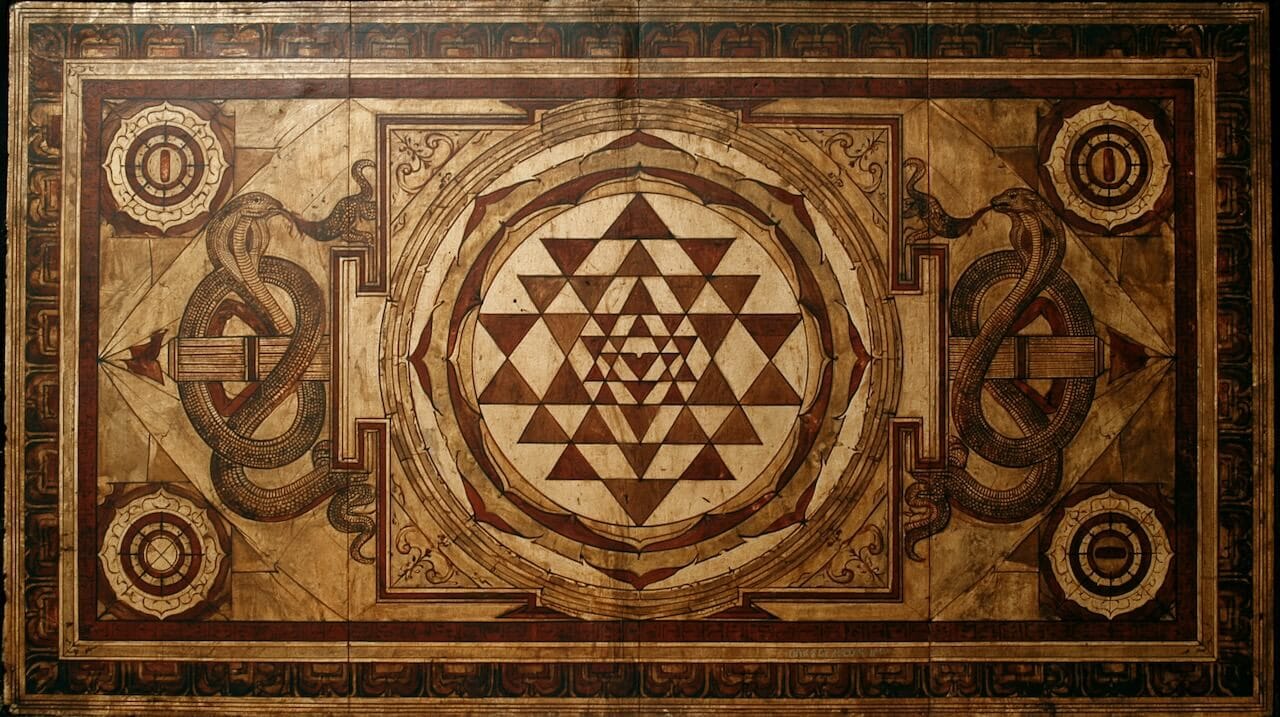
The central symbol of Śrī Vidyā is the Śrī Yantra, also called the Śrī Chakra, and it is neither decoration nor artwork. It represents at once the body of the goddess herself and the entire structure and unfolding of the cosmos, an image of consciousness and universe in one. Its geometry arises from the interlacing of nine principal triangles, five pointing downward for the feminine principle, Shakti, and four pointing upward for the masculine, Shiva, whose intersection generates forty-three smaller triangles. At the very centre is the bindu, the minute point that forms the absolute core, called the wheel wholly made of bliss, representing the goddess herself and the highest reality. Around it unfold rings of triangles and lotus petals out to a protective outer square with four gates, the material world. The Śrī Yantra thus shows how the One becomes the many, and meditation runs the other way, from the outer edge back to the centre, until the practitioner recognises that the consciousness of the observer and the structure of the yantra are one and the same.
The goddess at the centre, Lalitā Tripurasundarī, carries a name built from tri, three, pura, cities or worlds, and sundarī, beautiful: the most beautiful in the three worlds, eternally young and without equal. The three cities point to a deeper teaching, for her consciousness operates within and beyond the three states of waking, dreaming, and deep sleep, and within the three levels of the psyche, mind, discerning intelligence, and the memory of consciousness. She is the heart of Śrī Vidyā, and because she is the very substance of root knowledge, the tradition calls her directly Śrī Vidyā itself.
22. The ten great wisdoms
Śrī Vidyā is closely tied to the teaching of the Daśa Mahāvidyā, the ten great wisdoms, ten approaches to knowledge, ten dimensions through which reality can be seen. They are ten faces of the one Divine Mother, ten ways the same Shakti shows herself, and the tradition links their birth to a myth in which the Mother takes on powerful feminine forms to restore a balance that two demons had overthrown, the demons themselves being originally her own creations who misused their power.
The classical list runs: Kālī, the goddess of time and transformation, who devours time and destroys the ego; Tārā, the goddess of sound and compassion, who carries the seeker across the ocean of ignorance; Tripurasundarī, the beauty of the three worlds and the heart of Śrī Vidyā; Bhuvaneśvarī, the queen of the universe, who is to space what Kālī is to time; Bhairavī, the fierce goddess of the inner fire of tapas and awakened kundalini; Chhinnamastā, the goddess with the severed head, the most radical self-offering; Dhūmāvatī, the goddess of smoke in the form of an old widow, who teaches the sacred found in loss, age, and emptiness; Bagalāmukhī, the goddess who stills, not outer enemies but the endless flow of one's own illusory thought; Mātaṅgī, the tantric Sarasvatī of wisdom, art, and speech; and Kamalā, the tantric Lakṣmī of purity and true abundance. Each governs an aspect of cosmic power and offers a different path to the same knowledge.
One of these has an exceptional place in the practice of yoga, and it shows how exactly the terrifying image encodes an inner process. Chhinnamastā, whose name means she whose head is severed, is shown holding her own severed head while two streams of blood from her neck nourish two companions. A horrifying picture at first sight, it is in fact a precise description of an inner event: the two streams are the dissolution of the left and right energy currents, iḍā and piṅgalā, and when the two opposites are offered up, the path clears and the energy can rise through the central channel, suṣumnā. The severed head is the limited mind that must be transcended for the gate of liberation to open. That this reading is not a later addition is confirmed by one of her own names, Suṣumnasvara-Bhāsinī, she who shines with the sound of the central channel. Seen through depth psychology, these ten are not external goddesses but ten states of consciousness, ten of the archetypes of the collective unconscious, ten mirrors held up to one's own depths. Because the unconscious answers to images and not to logic, meditation on the terrible forms works as a controlled confrontation with the shadow, bringing suppressed force into the light to be transformed rather than destroyed.
23. Tantra and myth: gods as forces of consciousness
This is the seam where the two halves of the page become one, and it is worth making fully explicit. In the tantric understanding the gods and goddesses, Shiva, Shakti, Kālī, Lalitā, Bhairava, are not characters from old stories. They are the personification of real psychic and cosmic forces, archetypes that live both in the human psyche and in the structure of the universe. When tantric practice visualises Lalitā, it is not addressing an external goddess; it is activating in the practitioner the quality of consciousness she carries, beauty, harmony, cosmic intelligence. When it meditates on Shiva, it enters the state of pure presence behind the manifest world. The myth becomes the image of an inner experience.
This is why tantra reads myth exactly as depth psychology does, by translating rather than interpreting. A story of a god and goddess, of battle and marriage, of death and rebirth, is a record of inner transformation in the language of images, and the god is not someone outside but a force the practitioner recognises and awakens within. The deepest tantric myth, the relationship of Shiva and Shakti, says that consciousness and its energy were originally one and separated so that a world could appear, and that the whole of spiritual development is the path of their reunion. The image of Ardhanārīśvara, the divinity that is half man and half woman, captures the goal: the fusion of opposites in a single being, which is also the inner union of consciousness and energy, stillness and motion.
Tantric mythology is only one branch of a far wider world of myth, and the same patterns, the hero's journey, the descent into the underworld, death and rebirth, are found in the Greek, Norse, and biblical traditions as well. This is the deepest reason the two themes of this page are one theme. Myth across all cultures and tantra in the Indian tradition are both speaking the single language of the human psyche, once as story and once as practice, and a person who learns to read that language finds that the old images and the living path illuminate each other.
24. The guru, the lineage, and initiation
This is one of the largest differences between authentic tantra and neo-tantra. Authentic tantra is a strictly initiatory tradition, not something that can be learned from popular books or weekend workshops, and the reasons are practical rather than dogmatic.
First, a word about what a genuine guru is, since the term has been hollowed out. In the West the word has come to mean a cult of personality, a celebrity, the blind following of a leader, and from that distortion I keep my distance; it is right to be wary of it. But a true guru is something else entirely, and the word itself reveals it: gu means darkness, ru means light, and the guru is the one who leads from darkness to light. In this true sense the guru is indispensable in tantra, for reasons I will give, and the student does not surrender their own discernment but receives guidance where they cannot yet see for themselves. Between that guidance and the blind following of a celebrity lies an immense difference.
There are concrete reasons tantra cannot be taken from books. Its texts are often deliberately encoded, written in a twilight language in which the same word carries several meanings and the outer sense conceals the inner, so that without a living teacher to pass on the key, a reader stays on the surface. And tantra is a path of energy: a book can describe a technique but cannot transmit the energy, and without transmission the practice remains a mechanical activity without force. This is why the tradition speaks of knowledge passed from the mouth of the teacher, and why it rests on paramparā, the unbroken line of teachers and students that carries the tradition across generations. Initiation, dīkṣā, is the formal entry into that line, and it is not a ceremony but a real transmission of mantra, of the commitment to practice, and often of a direct touch of energy, śaktipāta, the descent of grace in which a dormant force awakens in the student through contact with the awakened consciousness of the teacher. This is not magic; the teacher loses nothing in the transmission, but allows what was always present in the student to catch light.
What this means in practice is simple. To begin tantra with no interest in the tradition and initiation is like studying medicine from popular books with no school and no clinical training: one can gain a surface impression, but one cannot become a real practitioner. This does not mean everyone must be initiated at once, and many of the basic principles, mantra, conscious attention, work with the body, meditation on a yantra, can be practised without formal dīkṣā. But the deeper forms and the true heart of the tradition open only in a living relationship with an authentic teacher. I name my own lineage not as a title but as evidence that what I pass on, I first received: my wife Kristýna and I were initiated into Śrī Vidyā through Sri Shivapremananda, in a process of more than two years, with further initiation in the Devipuram tradition.
25. What this is not
This is not myth treated as quaint old story, and it is not tantra treated as a sensual technique. I teach both as what they actually are, precise descriptions of inner transformation, and I will not flatter the popular distortions even though they are far easier to sell.
It is also not a synthesis that melts myth, tantra, and depth psychology into one new doctrine. I translate between them, show the same inner reality appearing in three languages, and help a person work with the tools that genuinely fit them; I do not build another dogma. And it is not a path to be walked alone from a web page. The deepest of this material, the work with kundalini, the transmutation of desire, the initiatory core of tantra, is transmitted only within a living tradition and under guidance, for reasons of safety as much as authenticity. Nothing here is a substitute for medical or psychological care, and a person in genuine crisis needs that care first. What a page like this can honestly do is restore the meaning of two badly distorted words, and show that behind the distortions stands something serious, coherent, and old.
26. Questions
No. Myth is not a failed explanation of nature but a precise account, in images, of inner transformation. The same motifs appear across unrelated cultures because they describe the common structure of the human psyche, which is why old stories still move people who do not believe them literally.
No. Authentic tantra is a complete path for developing consciousness through the body, breath, senses, and energy. Sexuality appears in some streams as a specific, ritually consecrated element, never as the main theme. The sexual reading is a modern Western distortion known as neo-tantra.
Traditional tantra rests on philosophy, ritual, ethics, meditation, and an initiatory lineage, and treats the body as sacred but not as the goal. Neo-tantra usually drops the philosophical and initiatory frame and focuses on intimacy and experience. They share little beyond the name.
Shiva is pure consciousness, the still principle; Shakti is creative energy, the dynamic principle. They are indivisibly one, and the aim of tantric practice is to recognise and live their underlying unity, within the cosmos and within oneself.
The dormant form of cosmic energy at the base of the spine. Tantra seeks its conscious awakening and ascent through the central channel to the crown, where Shakti unites with Shiva. It is a concrete energetic process, not a metaphor, and because an unprepared ascent can destabilise, the tradition insists on initiation and guidance.
Closely. The three energetic knots correspond to psychological fixations Jung and others described; the terrifying goddesses are images of the shadow; the awakening of kundalini maps onto individuation. Tantra works in the language of energy what depth psychology works in the language of the soul.
Its texts are deliberately encoded and need a living key, and it is a path of energy that books cannot transmit. A genuine guru, gu darkness, ru light, leads from darkness to light and gives guidance where a student cannot yet see, which is entirely different from the cult of personality the word has come to suggest in the West.
Some basic principles, mantra, conscious attention, work with the body, meditation on a yantra, can be practised without formal initiation. The deeper forms and the true core of the tradition open only in a living relationship with an authentic teacher.
27. Where to go next
Read. My essays on depth psychology and consciousness appear on Substack, roughly every week or two. They are the main place this work exists in written form.
Work with me. For those who want to take this from reading to their own sustained inner work, I take a small number of people into individual guidance over six to twelve months.
28. Sources and references
The substance of this page rests on primary sources, on the scholars of the tradition, and on the living lineage in which I was initiated.
On myth and the psyche: C. G. Jung: The Archetypes and the Collective Unconscious (CW 9i) C. G. Jung: The Psychology of Kundalini Yoga. Notes of the Seminar Given in 1932 (ed. Sonu Shamdasani, 1996) Joseph Campbell: The Hero with a Thousand Faces (1949) Erich Neumann: The Origins and History of Consciousness (1949) Jean Gebser: The Ever-Present Origin (1949) Mircea Eliade: The Sacred and the Profane (1957) and The Myth of the Eternal Return (1949) Robert Bly: Iron John. A Book About Men (1990) Robert A. Johnson: He, She, and We, and the reading of the Grail and of Eros and Psyche James Hillman: writings on image and the soul Marie-Louise von Franz: The Interpretation of Fairy Tales and writings on the feminine Heinrich Zimmer: Myths and Symbols in Indian Art and Civilization (1946)
On tantra, primary and scholarly: Abhinavagupta: Tantrāloka (the Light of Tantra) The Vijñāna Bhairava Tantra, on the methods of meditation Sir John Woodroffe (Arthur Avalon): The Serpent Power (1919) Georg Feuerstein: Tantra. The Path of Ecstasy (1998) Christopher Wallis: Tantra Illuminated (2012) Mark Dyczkowski: writings on the Spanda and Trika traditions David Frawley: Tantric Yoga and the Wisdom Goddesses (1994)
On the living tradition: The Śrī Vidyā lineage, through initiation with Sri Shivapremananda and in the Devipuram tradition founded by Sri Amritananda Natha Saraswati and Sri Annapurnamba. This is a living transmission rather than a book source, and the deepest material is held within it.
29. About author
I am Daniel Paulus. For more than twenty years I have studied and practised within Jungian depth psychology, comparative mythology, and the living tantric tradition. My wife Kristýna and I were initiated into the Śrī Vidyā lineage through Sri Shivapremananda, in a process of more than two years, with further initiation in the Devipuram tradition. I studied with teachers including David Frawley and Robert Svoboda, and I went through Stanislav Grof's training in transpersonal psychology.
I am not a guru in the Western celebrity sense, and I have not written a book. For two decades I also worked in senior roles in international companies, while the inner work ran alongside the whole time. What I bring is long study, lived practice, and initiation into a genuine lineage, and an insistence on teaching myth and tantra as the serious inner sciences they are rather than the distortions the market prefers.
In English I write and guide under my own name. I live between Europe and Costa Rica.
Related
The other two areas I teach each have their own page. Psychology and Consciousness treats the inner landscape these myths describe, the shadow, the archetypes, and individuation, in the language of depth psychology. Yoga and Meditation treats the path of practice, the eight limbs, the breath, and meditation, of which much grew from the tantric tradition.
My essays develop these themes in a more personal register on Substack.